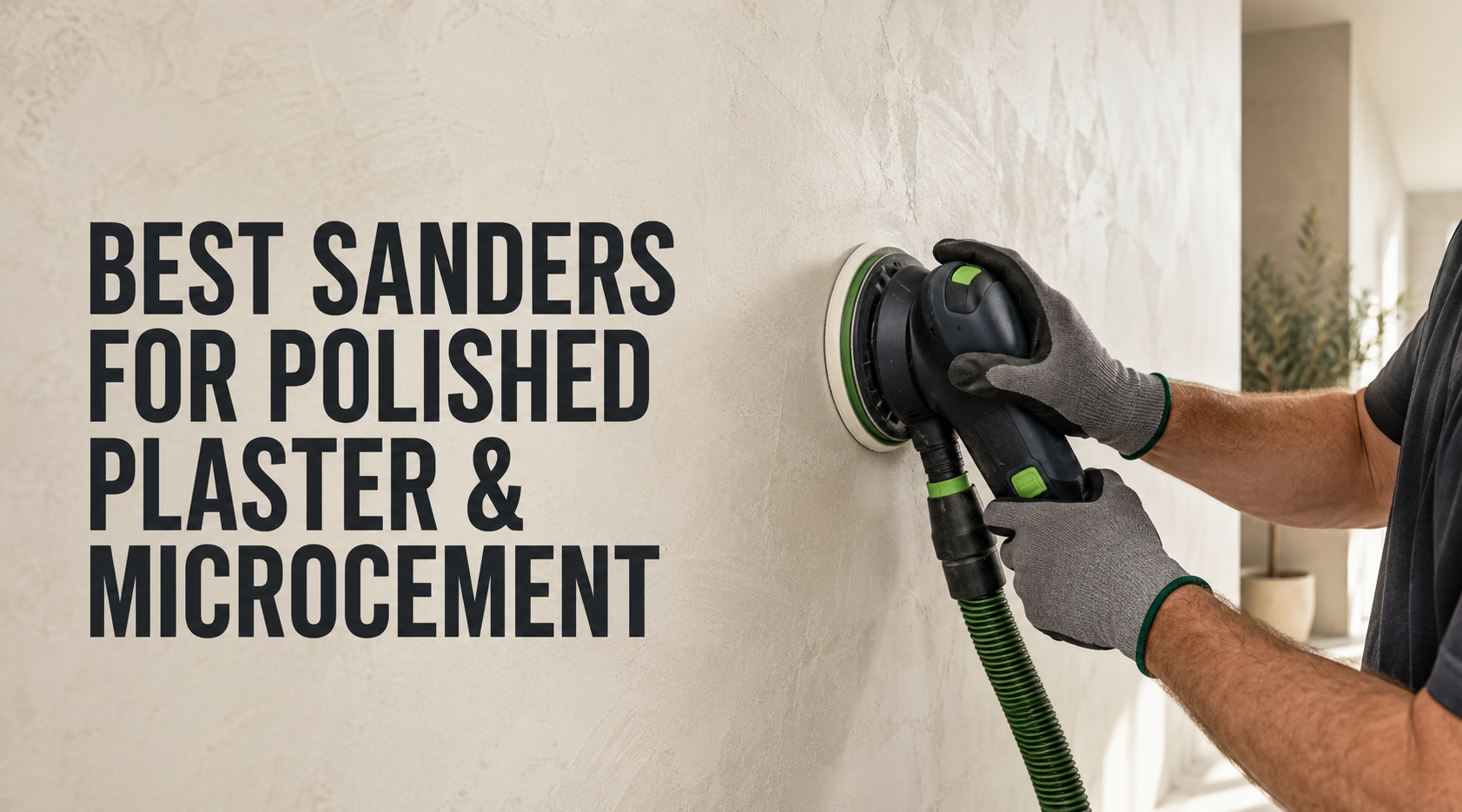
Decorative finishes such as polished plaster and microcement require more from a sander than standard wall preparation. The surface needs to be levelled efficiently, while the finer finishing stages require control to help avoid deep scratches, uneven areas and visible sanding marks.
For trades working with finishes such as Masterwall Valencia Acrylic Face, Tufftex and microcement, the Festool-recommended approach is to use two complementary sanders:
- Festool ROTEX RO 150 for preparation, levelling and heavier material removal.
- Festool ETS 150 for controlled intermediate and fine finishing.
Rather than expecting one sander to perform every stage perfectly, this combination provides the power required for the initial preparation and the lighter, more refined control needed as the finish develops.
Why Use Two Sanders for Polished Plaster?
Polished plaster, microcement and textured acrylic finishes can involve several different sanding stages.
Raised areas, joins and surface imperfections may require more aggressive levelling. Later coats generally require a lighter, more controlled approach to refine the surface without creating pronounced sanding marks.
A powerful sander can make the preparation stage faster, but it may be too aggressive for prolonged fine-finishing work. A dedicated finishing sander provides excellent control but can take considerably longer when substantial levelling is required.
The Festool ROTEX RO 150 and ETS 150 address these different requirements as a complementary professional sanding system.
Stage One: Festool ROTEX RO 150 for Preparation and Levelling
The Festool ROTEX RO 150 is the workhorse of the combination. Its multi-mode design makes it suitable for demanding surface preparation, intermediate sanding and polishing applications.
For polished plaster and microcement work, the RO 150 may be used when the applicator needs:
- Faster levelling of raised areas and surface irregularities
- More effective material removal during preparation
- A choice of aggressive and random-orbital sanding modes
- A 150mm sanding platform for covering larger areas efficiently
- Compatibility with suitable Festool dust extraction
The ROTEX geared mode provides more aggressive material removal than a conventional finishing sander. Once the heavier preparation work is complete, the operator can change modes or move to an ETS 150 for greater control.
The RO 150 is powerful and versatile, but it is not Festool’s lightest option for continuous fine sanding. This is where the second part of the system becomes valuable.
Stage Two: Festool ETS 150 for Fine Finishing
The Festool ETS 150 range is designed for controlled random-orbital sanding and high-quality surface finishing.
For delicate finishing work, the Festool ETS EC 150/3 is an especially strong option. Its fine 3mm sanding stroke helps refine the surface while reducing the risk of pronounced sanding marks.
The compact ETS EC 150/3 weighs approximately 1.2kg without accessories, making it easier to control during extended sanding on vertical surfaces.
It is well suited to:
- Intermediate and fine sanding
- Refining the surface after initial levelling
- Extended use where low weight and ergonomics are important
- Controlled sanding on vertical walls
- Helping achieve a consistent surface before the specified final treatment
Is There a Cordless Festool Option?
For applicators who prefer cordless operation, the Festool ETSC 2 150 offers a 150mm sanding pad, a 3.5mm sanding stroke and an integrated LED light.
The built-in light can help reveal surface irregularities and sanding marks while working. This makes the ETSC 2 a convenient option for controlled finishing and work where access to power is limited.
However, the cordless ETSC 2 should be selected according to the required process. It does not replace the more aggressive levelling capability of the geared ROTEX RO 150.
Which Festool Sander Should You Choose?
Choose the ROTEX RO 150 if:
- The priority is levelling or faster material removal.
- The surface requires more substantial preparation.
- You want one versatile machine with multiple operating modes.
- Polishing capability is also important to your workflow.
Choose the ETS EC 150/3 if:
- The priority is fine finishing and surface control.
- Low weight is important for prolonged vertical work.
- The heavier preparation has already been completed.
- You want a machine designed to produce a refined random-orbital finish.
Choose the ETSC 2 150 if:
- Cordless convenience is important.
- You primarily require controlled intermediate or fine sanding.
- An integrated surface light would help identify imperfections.
- You already use the Festool 18V battery platform.
Choose the RO 150 and ETS 150 if:
- You regularly apply polished plaster, microcement or textured architectural finishes.
- You need an efficient professional workflow from preparation through to finishing.
- You do not want to compromise between material-removal speed and fine control.
For professional applicators completing the full process, the strongest overall recommendation is the ROTEX RO 150 for preparation, followed by the ETS EC 150/3 for fine finishing.
Abrasives, Pads and Dust Extraction Matter
The sander is only one part of the overall system. Abrasive type and grit, backing-pad hardness, interface pads, machine speed and dust extraction can all affect the finished result.
Always follow the coating manufacturer’s current application instructions. Begin with a test area and use the least aggressive combination that achieves the required result.
Decorative finishes can vary in hardness, layer thickness and curing time, even when they appear similar. The correct process for one microcement or polished-plaster product may not suit another.
Suitable dust extraction is also important for visibility, abrasive performance and maintaining a cleaner work area. The required extractor and filtration class will depend on the material being sanded and the relevant workplace-safety requirements. Always check the product safety data sheet before beginning work.
Get Expert Festool Advice at Beyond Tools
Beyond Tools is a Festool Premium Shop and authorised Festool service agent in Malaga, Western Australia.
Our team can help professional applicators compare the ROTEX RO 150, ETS EC 150/3 and cordless ETSC 2 150, as well as select compatible abrasives, backing pads, interface pads and dust-extraction equipment.
Visit our Malaga showroom to handle the machines and compare their weight and ergonomics, or shop the Festool range online at Beyond Tools.
Big on Tools. Big on Machinery. Big on Service.
Frequently Asked Questions
What is the best Festool sander for polished plaster?
For a complete professional system, use the Festool ROTEX RO 150 for levelling and preparation, followed by an ETS 150—particularly the lightweight ETS EC 150/3—for controlled fine finishing.
Can one Festool sander do the whole job?
The RO 150 is the more versatile single-machine choice when both material removal and finer sanding are required. However, changing to a lighter ETS 150 for the final stages can provide better control and reduce operator fatigue.
Is there a cordless Festool sander for polished plaster?
Yes. The Festool ETSC 2 150 is a cordless 150mm random-orbital sander with a 3.5mm sanding stroke and integrated LED light. It is suited to controlled finishing but does not replace the aggressive levelling capability of the geared RO 150.
Can this system be used on Masterwall Valencia Acrylic Face, Tufftex or microcement?
These are among the finish types for which professional applicators may use the RO 150 and ETS 150 workflow. Always confirm the correct sanding stage, abrasive, speed and curing requirements with the coating manufacturer because specifications can vary between systems.
Which is lighter: the ROTEX RO 150 or ETS EC 150/3?
The ETS EC 150/3 is the lighter finishing machine, weighing approximately 1.2kg without accessories. The RO 150 is heavier because it is designed to provide more powerful geared sanding and multi-mode capability.
Last updated: 28 August 2026
This guide is reviewed regularly to reflect current Festool products, application advice and availability at Beyond Tools.